




5-minute read

NJ man with disability is fighting a $3,390 ambulance bill: video
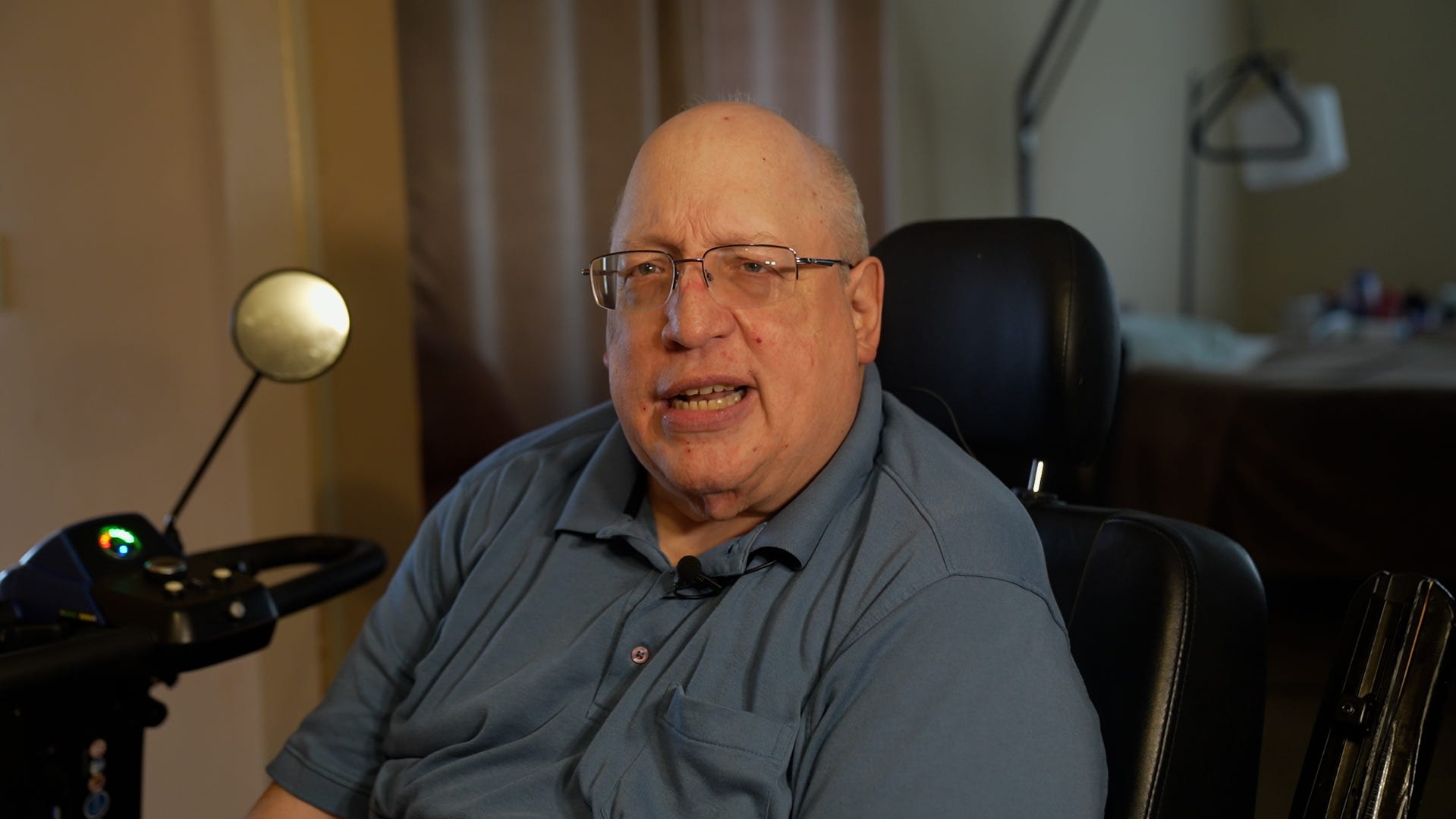
Ed Heaton is fighting a $3,390 ambulance two years after surgery where he had to be transported by a stretcher.
- His insurer, Horizon Blue Cross Blue Shield, denied the claim, saying the ride was for “non-emergent transportation.”
- Despite multiple appeals and a letter from his surgeon, the denial has been repeatedly upheld by the State Health Benefits Commission.
- Advocates say insurance denials often disproportionately affect people with disabilities, who face more barriers to care.
Days after Ed Heaton had surgery to repair his broken shoulder in May 2023, he was transported from a rehab facility in Essex County to his surgeon’s office for an exam.
Because Heaton has cerebral palsy and is paraplegic, his rehab facility had booked an ambulance so he could more easily be transferred from a bed to a gurney.
Moving him onto his medical scooter using a small crane called a Hoyer Lift and into an ambulette van would have been excruciatingly painful after surgery.
Weeks later, Heaton got an unexpected denial from his medical insurer for the ride. The bill for the 26-mile round trip: $3,390.
Heaton has been fighting the bill for more than two years through a bureaucratic maze that he calls “theater of the absurd.” He now has a court date in December that may determine whether he has to pay.
Story continues below photo gallery.
“It’s obvious I’m disabled,” he said. “They want to put me through all this for a bill that, in my mind, should be covered. I’m not the average person who has shoulder replacement surgery. What did they want me to do? Get up and tap dance?”
Insurance denials have long been one of the most infuriating and deflating aspects of the modern health care system. When UnitedHealthcare CEO Brian Thompson was shot and killed on a Manhattan street last year, it unleashed a torrent of criticism against the insurance industry, exposing the American public’s deep resentment when it comes to denials.
But even with rhetoric from politicians in the immediate aftermath of the shooting, the torrent of criticism has not led to any major industry reforms or an increase in transparency.
Despite some reports and research limited to Affordable Care Act policies, there is a lack of data on insurance denials — whether they are rising, how often they are issued, if there are particular circumstances more likely to trigger denials and whether certain groups of people receive more of them.
Advocates say denials similar to Heaton’s aren’t isolated incidents, but reflect a broader pattern in which insurance barriers fall hardest on people with disabilities — patients who already face limited options for accessible care.
Heaton’s story is part of Hurdles to Health Care, a NorthJersey.com series that examines the many challenges patients with disabilities face in getting quality care.
“The system too often makes them fight for the care they need,” said Paul Aronsohn, the New Jersey ombudsman for people with intellectual or developmental disabilities. “That’s not just bureaucratic — it’s a moral failure.”
One man’s fight
Heaton was born with cerebral palsy, a group of developmental conditions with a wide range of severity but most commonly characterized by complications with movement.
Heaton, 65, walked with crutches and braces most of his life until leg swelling and other health issues forced him to use a scooter when he was 48.
Despite some chronic health problems, Heaton lives a full life. He owns a home in Union County, has been married to his wife, Anita, for 28 years and has worked at Costco for 13 years, checking memberships and receipts.
In March 2023, Heaton fell off his scooter and badly damaged his left shoulder — his dominant side. At the time he was fighting with his insurance company to replace his three-wheeled scooter for a more stable four-wheel model. He underwent surgery in May at Overlook Hospital in Summit, where his shoulder joint was replaced with artificial components.
Six days later he was taken by ambulance to a rehab facility in Livingston. The 10-mile trip cost $564 and was covered by his insurance — Horizon Blue Cross Blue Shield — that he gets through Anita’s state government job.
Heaton said he was all but immobilized at this point in his recovery, bedridden and unable to do basic tasks such as feeding himself.
Heaton’s surgeon needed to see him for a follow-up visit at the surgeon’s Berkeley Heights office to assess how the recovery was proceeding.
The rehab facility called an ambulance because of Heaton’s condition. He was transported back and forth without incident.
Heaton spent 29 days at the rehab center before he was well enough to go home.
A few weeks later, Anita logged onto Horizon’s online portal and saw the denial. “My first reaction was disbelief,” she said. “It made no logical sense to me. Ed couldn’t do anything at that time — let alone get into his scooter.”
Appeals, testimony and a court date
A Horizon representative would later write in a denial letter that the ambulance was used for “non-emergent transportation,” which is not covered by the policy. Ambulances are covered only for “local emergency transport to the nearest facility equipped to treat the emergency condition,” said a letter from Horizon to the Heatons.
The ambulance company agreed not to demand the $3,390 until the case was resolved, Heaton said.
“It’s a pretty damn big hit, and we’d have to start a payment plan,” Heaton said. “You have payment plans for a car, a house — not a 20-minute ambulance ride.”
The Heatons appealed to Horizon, and the denial was upheld.
Aronsohn has often criticized the health care system for the outsized role health insurance companies have in it. Denials are easy. Challenging one is hard.
“People with disabilities and their families are fighting two battles — one with their disability and one with the system that’s supposed to support them,” Aronsohn said about such cases in general.
Next up was an appeal to the State Health Benefits Commission, the board that oversees health coverage for government workers.
The Heatons traveled to Trenton to appeal directly to the commission during a public meeting in September 2024. The commission upheld the denial, using the same argument that Horizon had used. The couple appealed that decision and returned to face the commission four months later in January.
The commission did not change its decision.
A third attempt with the commission was made this past September. Heaton’s union representative, Jim McAsey, told the board about Heaton’s “cornucopia of serious health conditions,” including diabetes, anemia and a congenital heart condition. Heaton had a stroke in 2010.
“Because of all of his health conditions, what may not be an emergency for some patients can be an emergency for Mr. Heaton,” McAsey said.
Heaton’s surgeon, Dr. Matthew Garberina, wrote a letter to the commission supporting his patient.
At the time of his post-surgical exam, “Heaton was still unable to transfer to a wheelchair and required a stretcher transport to and from my office,” Garberina wrote. “I am asking you to cover the medically necessary transportation to and from my office for his post operative care.”
Tom Wilson, a Horizon spokesman, said the State Health Benefits Program chooses which benefits are covered by its plan — Horizon only administers those benefits. “The State Health Benefits Commission reviewed this matter on appeal and agreed that the State’s plan does not provide coverage for non-emergency transportation, such as between a rehabilitation facility and a doctor’s office,” he said in a statement.
The commission did not change its stance after the September hearing. The case is now headed to an administrative law judge, who makes preliminary rulings on conflicts within state agencies. A court date is set for December.
“I suspect they’re afraid that if they give it to me, they’ll have to give it to others in the same predicament,” Heaton said. “They should pay for an ambulance when there’s no other choice.”
link
More Stories
Preparing a “Landing Pad”: Mitigating OBBBA’s Harms to the Medicaid Safety Net
Adults with Intellectual and Developmental Disabilities Face Critical Mental Health Care Gaps, New Study Finds
Alabama Neurodevelopment Center aims to boost mental health resources in Birmingham, the state