



Dramatic breakthroughs in medical research in recent years have made it possible for millions of Americans to live longer and live better.
You may be one of them.
And many of those welcomed advances came from research in Tennessee.
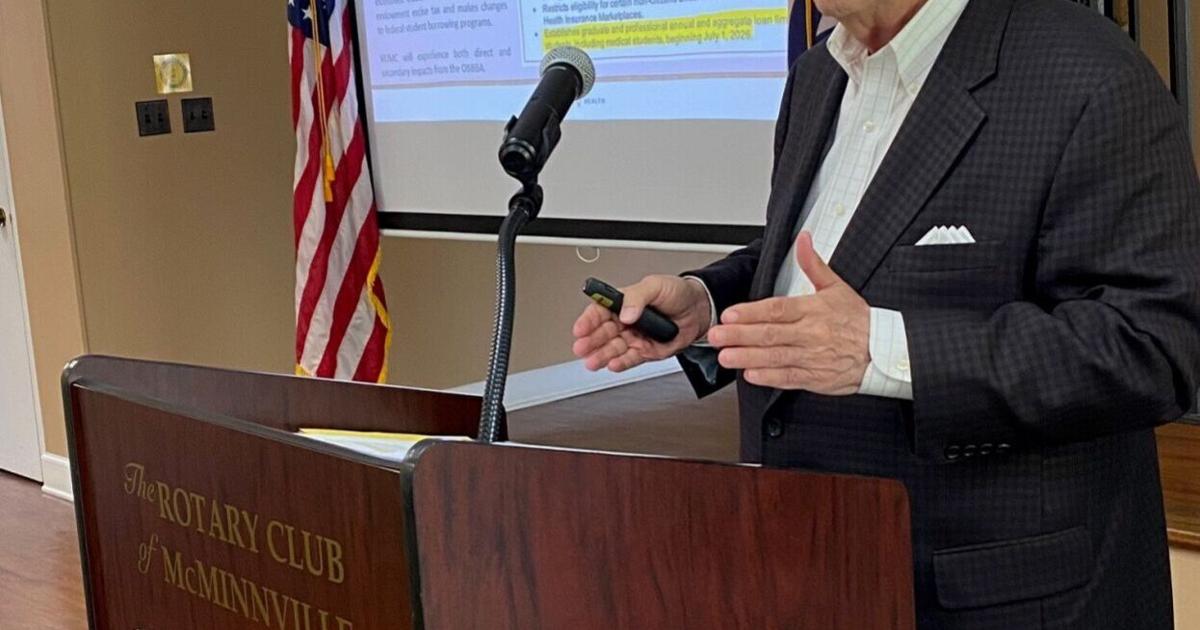
But America’s decades-old leadership in biological and medical science could be coming to an end, Dr C Wright Pinson told The Rotary Club of McMinnville.
“We have been in a very, very promising era in medical research,” he said at the weekly Rotary luncheon in the fellowship hall of First Presbyterian Church. “This has been an era of great breakthroughs.”
“When I started [in medicine] 45 years ago, these were considered a death sentence,” he said of certain dreaded diagnoses, including lung and throat cancer. “Now they are being routinely treated,” bringing good reason for hope to patients and their families.
But the flow of taxpayer funds that made much of the basic and applied research possible was abruptly terminated or sharply curtailed with the arrival of the second presidency of Donald Trump, who has been exercising his executive authority to cancel federal grants and freeze government funding to institutions like Vanderbilt University Medical Center and Vanderbilt University.
“In the year just ended our research budget was down three percent” compared to the previous year. “We’re looking for a 20-25% decline next year,” he said, referring to the US government’s main channel for distributing research grants, the National Institutes of Health (NIH). We can know with high degree of certainty the research products that are already extending and improving lives.
“What we can’t know, Pinson muses in a WCPI interview, are the possibilities we miss if the effort is cut off, the powerful discoveries and life-changing inventions that won’t happen because we abandoned the search.
He shares facts, figures, professional analysis and reflections this Tuesday, Aug. 5, at 5 p.m. and again Saturday at 9:35 a.m., in the weekly FOCUS interview series on McMinnville Public Radio 91.3-WCPI.
“If we cut back on our research it will not only cut off advances in the future but affect the immediate economy,” he observed at the Rotary luncheon. Besides the direct benefits from laboratory and clinical research, the millions of dollars that had been coming into Tennessee generated a strong secondary effect in the surrounding communities, he emphasized.
According to an NIH study, every dollar spent on research in 2024 spun off another $2.46 in collateral economic activity. When scientists, lab assistants and clinical associates lose their jobs, the downdraft in the area economy is immediate and powerful.
“As of June 4, NIH had terminated 2,282 grants totaling $3.79 billion, according to an analysis by the Association of American Medical Colleges,” the Nashville Business Journal recently reported.
“Tennessee alone lost $40.92 million in NIH funding across the board, according to the analysis. Through April, the agency had given out $1.6 billion less than it did in 2024, a one-fifth reduction, a New York Times analysis found. In a typical year, there are fewer than 20 grant terminations each year,” the Nashville Business Journal stated.
Besides NIH, the other major conduit for US government funds in research has been the National Science Foundation (NSF).
“As of early June,” the NBJ article noted, “Vanderbilt University had lost six of its National Science Foundation grants, which were expected to bring in $2.7 million. The loss of those grants alone would instantly drain more than $9 million from the Nashville area economy if the NIH model provides a reasonable approximation.
But the future losses loom even more menacingly, Pinson argues, explaining that much of America’s brightest, most creative and hard-working talent could be forced out of the nation’s research centers. Several foreign countries pounced soon after the Trump administration began slashing the grants.
Canada and a number of European and Middle East universities have been reaching out to US scientists to offer positions in a welcoming and supportive environment—and reduced paperwork burden when applying for government support.
Pinson noted in the WCPI FOCUS recording that NIH and NSF funded only a small fraction of the competitive grant applications they received annually. By drastically shrinking that pool of money, American scientists face even greater challenges in holding on to their research programs and working on new ideas and possibilities.
“The cuts have left Nashville researchers afraid, discouraged and, in some cases, jobless,” reporter Nikki Ross wrote in the Nashville Business Journal.
“And more cuts are on the way. President Donald Trump[‘s] proposed 2026 budget calls for an additional $18 billion, or 40%, cut to NIH funding. It also calls for a reduction and combination of the NIH’s 27 centers.” Included in those centers are the nation’s leading research thrusts in cancer, Alzheimer’s, heart disease, diabetes, neurological disorders and childhood health problems.
An exemplary and undisputed global leader in biological sciences and medical advances since World War II, America could sink to second-place status in these areas in the future, Pinson suggested in the WCPI interview.
Pinson was born at the top-secret Los Alamos NM laboratory that produced the American atomic bomb that hastened the end of World War II. The son a Manhattan Project scientist, he spent his early career as an engineer at IBM before earning an MBA. He then entered medical college, received his MD and ultimately headed the organ transplantation program—the nation’s third largest—at VUMC.
At the end of June he stepped down as deputy CEO at VUMC after 35 years of service at the 1,174-bed hospital, the largest in the Nashville market area. Pinson moved laterally into a position overseeing the institution’s government and community relations.
link
More Stories
McConnell secures $2.6B in federal funding for Kentucky, boosting Louisville redevelopment and research
North America Pre-clinical Scientific Research Medical Device Market Report 2033
75 years ago, her cells were taken without consent. Today her family honors her legacy to make sure it never happens again