



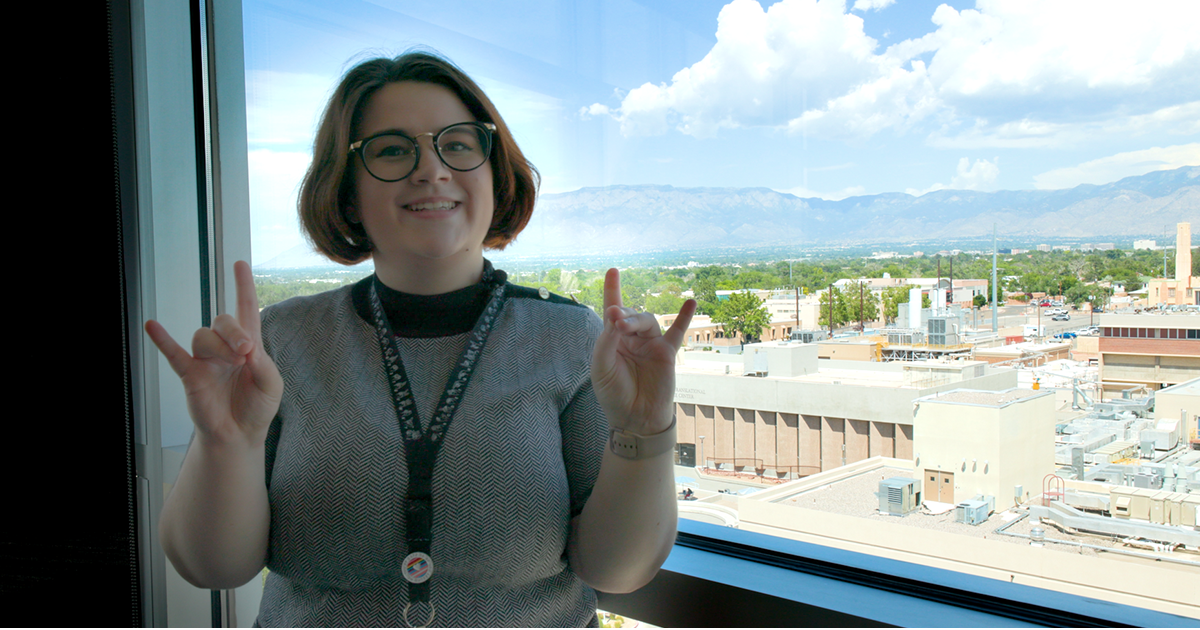
At age seven, Audrey Eakman began to experience progressive hearing loss.
With her family’s help and encouragement, she learned how to navigate the world with a hearing disability — a place, as she put it, “not designed” for people like her. She is now a fourth-year student at The University of New Mexico School of Medicine, pursuing a Doctor of Medicine degree — and paving the way for others like her.
As the first Deaf student who uses American Sign Language (ASL) admitted to the UNM School of Medicine, Eakman is passionate about opening doors for people with disabilities to become health care providers. She also said she wants to deliver better care to patients with disabilities, who have historically been underserved.
“I have the opportunity and the privilege to represent my community in the School of Medicine,” Eakman said. “We often are not given the opportunities to pursue higher education — oftentimes it’s not accessible to us. So, the fact that UNM has worked with me and allowed me access to interpreters has been very beneficial.”
Eakman uses hearing aids and language interpreting to understand communication. She said UNM’s Accessibility Resource Center provides ASL interpreters who join her in the classroom and in clinical settings. She also said UNM has a “strong culture of inclusion” that has helped her succeed in medical school.
“What it also means to me is that I get to represent my community in health care,” Eakman said. “People with disabilities don’t always have the best experiences with the health care system, and so people with disabilities being health care providers, being doctors, being nurses, improves the quality of health care that people with disabilities receive.”
Every day that I get to work with a Deaf patient and communicate with them directly in our shared language, it’s always a really huge success for health care and for the health of the people with disabilities.
-Audrey Eakman, Fourth-Year Student, UNM School of Medicine
Misconceptions about disability still persist.
They can be as simple as someone not knowing Eakman can speak (she can), or as serious as someone thinking that a health provider with a disability is a danger to her patients, she said.
“I can assure you that nobody is working harder for patient safety than doctors and nurses with disabilities, because they completely understand their limitations and they also know how to overcome them, because we’ve been doing that our entire lives,” she said.
Eakman said she takes challenges like these as moments for sharing and teaching.
“I try to make sure that all of those opportunities are teaching moments for people, and I feel like most of the time, people are very happy to learn more about what people who are Deaf can actually do,” she said.
In fact, being Deaf has made her a better health provider, Eakman said.
“There are a lot of benefits to being Deaf,” she said. “We call it ‘Deaf Gain.’”
For example, she said she is able to empathize with patients who have a disability, and she has also increased her ability to innovate by living and working in environments not always created for people with disabilities.
“That creativity is a really huge benefit for medicine and for health care, because it’s a constantly evolving field.”
Eakman has further contributed at UNM by helping develop curriculum and conducting research related to disability and accessibility. After graduation, she said she plans to complete a residency in family medicine, then practice in New Mexico, taking care of patients who are Deaf or have another disability.
Eakman has been happy with her successes so far.
“Every day that I get to work with a Deaf patient and communicate with them directly in our shared language, it’s always a really huge success for health care and for the health of the people with disabilities,” she said.
link
More Stories
Preparing a “Landing Pad”: Mitigating OBBBA’s Harms to the Medicaid Safety Net
Adults with Intellectual and Developmental Disabilities Face Critical Mental Health Care Gaps, New Study Finds
Alabama Neurodevelopment Center aims to boost mental health resources in Birmingham, the state