


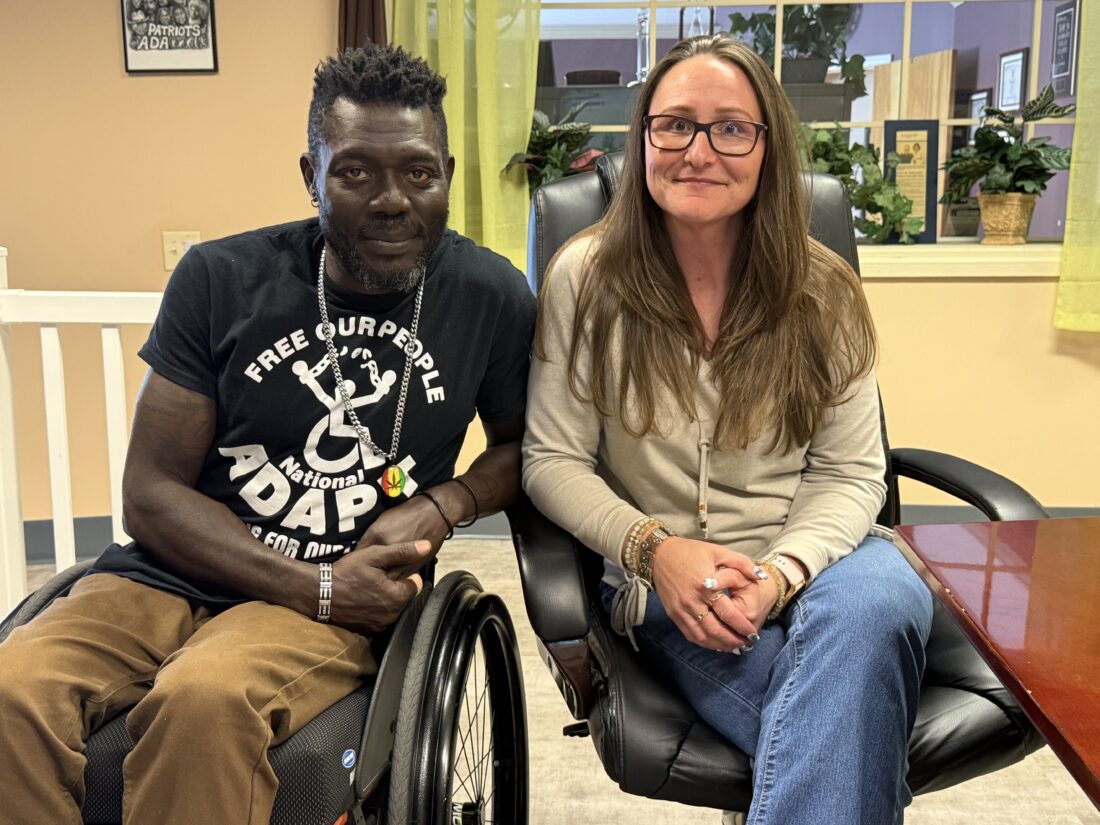
As Congress considers reducing funding for Medicaid and several other programs they deem wasteful, a member of the disability community wants people to know that there is a misconception about who really benefits from these programs.
“With what the government is talking about — slashing Medicaid, Medicare, housing, education, all that — people think it is not going to just affect me. It is going to affect a lot of people, not just people who are disabled, but the elderly, the young who are growing up with disabilities, who are aging in place, who need to be independent by themselves,” said Guy Anthony Brooks, who is an activist with ADAPT (American Disabled for Attendant Programs Today), a grassroots organization that works at providing programs and services for people with disabilities.
Brooks, who navigates the world in a wheelchair, had lived in an institution for two years until moving to an accessible, affordable home 15 years ago. The home had been built by the Center for Independent Living in Philadelphia.
He wants people to think about that — there are really only two options open to people with disabilities, either their care is provided in the institutional setting or in their home.
“We need education. We need knowledge for the community to know that we, people with disabilities, are part of the community. We need affordable, accessible homes, accessible sidewalks, accessible curb cuts,” he said.
“Don’t restrict our liberty from being independent in the community. But still, we have this plight about accessible, affordable homes. You know, you’ve heard about it. You’ve seen it. The only place a person with a disability — be it physical or invisible — is living in is an institution. I lived in one. I never want to experience that again,” he said.
“That’s a place where somebody would be forgotten about and die off. But you have a life to live where you can be free and happy and independent in the community, but because you have a disability, the only place they say you are able to function is an institution, which is not right,” he added.
The right to community living is degraded by persistent underfunding and bias in federal Medicaid law that prioritizes institutional care over home and community-based services (HCBS), threatening to increase PA’s Medicaid spending and lead our older adults and people with disabilities to be admitted to nursing facilities and other institutions against their will, according to Misty Dion, CEO at the Roads to Freedom Center for Independent Living — a disability rights organization that provides a range of services for people of all ages and disabilities in North Central PA.
On the one hand, under Medicaid, someone with a disability qualifies for costly institutionalized care, and waives that right to apply for cheaper, higher quality care that would allow them to stay in their home and remain in the community, waiting months to receive services.
But, in 1999 a ruling by the Supreme Court, which would become known as the Olmstead Mandate, stated that “unjustified segregation of persons with disabilities constitutes discrimination in violation of title II of the Americans with Disabilities Act.”
The court further stated that “institutional placement of persons who can handle and benefit from community settings perpetuates unwarranted assumptions that persons so isolated are incapable of or unworthy of participating in community life and that “confinement in an institution severely diminishes the everyday life activities of individuals, including family relations, social contacts, work options, economic independence, educational advancement, and cultural enrichment.”
“It is this entitlement to institutional care, and our right to community living under the ADA Olmstead Integration Mandate, where Medicaid comes in,” Dion said.
Medicaid covers long-term care in the institution, which Dion noted costs about three times as much as caring for someone in their home.
“Medicaid institutional care is costly (and) it’s not individualized,” she said.
Dion noted that Nursing Facilities receive a 24-hour payment for each resident who received around two and a half hours of individualized care, but after COVID highlighted the problems we already knew existed in nursing facilities, the mandate for how many hours needed to be spent with an individual before they could bill for a full day increased to 3.48.
“Now, in the home and community-based services, homecare workers, often with the same credentials but paid significantly less, have to count for every 15 minutes of their time, or the time of the people working with them, or services. And, in a nursing facility, there are no incentives for residents to get better, facilities are paid by Medicaid whether your health improves or not, a head laid, is a bed paid” Dion said.
“So my point in saying all that is, not only are home and community-based services our right under the Olmstead Integration Mandate, they are cheaper, by far, if you want to talk about efficiency and cutting Medicaid, investing in home and community based services is the answer to lessening our Medicaid expenses,” she continued.
“And then lastly, and it’s not just what endless studies have shown us or the fact that none of us know anyone who has ‘dying in a nursing home’ in their will, it’s because we know the quality and span of life are better in the community, not isolated in an institution,” she said.
Brooks’ time in an institution bears that out as he shared that he had experienced the deaths of friends he had met there, often for something that would not have been fatal if they had received care earlier.
There is a loss of control when care is received in an institution as opposed to home or community-based care.
“I’m not in control,” Brooks said. “But when I’m in the community, in my own home in the community, I have control of everything. When I wake up, when I go to sleep, when I want my personal care attendant to come visit me, come and help me. I give them the regulated time. Come see me in four hours, go back, come back in the next four hours,” he said.
“But in the institution, you have more than, I’ll say, six people in one room, sometimes 10 people in one room, and that personal care tenant has to facilitate all of them in that room. I experienced it. It took them only five minutes with me before they moved on, and I’ll press the call button. It takes them hours before they come in,” he said.
“People are just ignored. They are maltreated. They are told that, oh, you’re being belligerent. So we will give you this medication to let you be calm,” he added.
From his firsthand knowledge of life in an institution, one thing is very clear — he does not want to be forced to go back. And yet, that is a real fear that the disability community deals with.
“Yeah, absolutely, we know that we’ll go back into institutions,” he said.
“There’s a concern right now, that the administration’s proposed budget, which we know doesn’t often pass, but nonetheless, it’s a blueprint of where our government is looking to go, and in that blueprint, it shows drastic changes and cuts for foundational, widely supported, and critical lifesaving services that keep people in their community,” Dion said.
“It’s 2.3 million children with disabilities, 8.8 million working-age adults with disabilities, and 4.4 million older adults with disabilities. Also, take into consideration that you’re still going to have to serve them. Are you going to put them in a nursing facility? If that’s the answer, how are you going to cut Medicaid? How are you going to do cost savings,” she said.
“The answer is Home and Community Services, the services we’ve fought so long to get, and now we’re backsliding. In Pennsylvania, if you look at Medicaid expenses, the Medicaid dollars that went into long-term care versus Home and Community Based Care have been successfully rebalanced to the point that we are serving more people in the community,” she said.
At least 74% of Medicaid dollars are being spent on home and community-based services in Pennsylvania, she said, as opposed to nursing homes.
That’s one reason that quality services in the community have been provided while keeping people out of nursing homes.
“With the proposed budget cuts, that’s not going to happen,” she said.
The administration has also talked about putting work requirements on Medicaid.
“There needs to be exceptions for those work-related requirements, because the thought that Medicaid recipients are bums that can and should work is simply not true,” she said.
Some of the work-related exceptions, she cited, that were needed, are for children enrolled in Medicaid or CHIP; pregnant women; disabled individuals, including individuals who have a medical condition or complex medical needs; individuals over the age of 65; individuals who are the primary caregiver of a child or someone who is disabled; individuals receiving Social Security Disability Insurance (SSDI) or Supplemental Security Income (SSI); individuals participating in a Medicaid-covered treatment program for alcohol or substance abuse addiction, including opioid addiction; individuals receiving treatment for cancer, or other case-specific basis exemptions. This includes certain individuals with medically complex conditions that require multidisciplinary specialized care or would otherwise be precluded from employment or community engagement activities due to their health status.
Speaker of the House Mike Johnson, recently said that “Medicaid is not for 29-year-old males sitting on their couches playing video games.”
“When he said that I said, is he talking about me? Yes, I’m a person with a disability. Sometimes I lay in bed to work. Sometimes I sit in my chair to work. So if you’re saying people who are disabled and staying home, you’re putting us all under the same umbrella, because you said some of them are not really as disabled as they perceive to be,” Brooks said.
“Some have invisible disabilities. Some have physical disabilities. Some people with physical disabilities cannot do as much as those with invisible disabilities. It is both ways. Everybody’s disability is not the same, but they perceive that everybody’s disabilities. So first, you’re physically disabled, you’re all the same. You’re invisibly disabled, you’re all the same. No, it is not like that,” he said, the frustration evident in his voice.
If Congress does move ahead with the cuts to Medicaid, Dion said that there are people who don’t realize they utilize Medicaid, and won’t realize until it’s gone.
“Sometimes people don’t realize that CHIP, that’s Medicaid. Some of your veteran services, some of them are Medicaid. It depends what they’re getting, waiver services, Medicare. All of these things come into play. And so sometimes there’s a large part of our community who has this misconception of who are Medicaid recipients, when it’s themselves,” Dion said.
“In many cases, we’ve had people come in here and talk about, you know, well, I’m not on Medicaid, and I’m like, well, actually, if you’re receiving these types of insurances that’s funded through Medicaid. Those people aren’t your bums sitting at home playing games, or whatever the thought is. So we’re very fearful there’s a lack of communication, a lack of transparency as to what’s even going to happen, let alone people’s understanding of how that will affect them,” she said.
There is a lot of information about what might happen if Medicaid is defunded-will states take over; do states have the funding for that; what services would be discontinued. But all the data out there can’t replace the fears of the people who will be affected by the cuts.
“What the government is doing right now by cutting all the services to citizens of the country, will kill us without our medications, without all the services. Some people have even started seeing their SNAP benefits cut, food assistance,” Brooks said.
“So not just the civil rights and your life and liberty, and the fear of going to an institution, but the bottom line, I hope we delivered here, is these services and these programs here that we’ll lose — they’re efficiency. They’re literally a Medicaid efficiency program buy-in (and a) third of the cost of an institutional setting. I don’t know what else to say, other than this is efficient for Medicaid,” Dion said.
“So instead of cutting federal funds that help support that, why not use the funds to support the home and community-based care instead of the institutional care? That would both save lives and money,” Dion said.
link